
Waterproofing
French Drain vs Sump Pump: Which One Does Your Florida Home Need?
French drains and sump pumps both manage water but solve different problems. Here is how to figure out which one a Florida home actually needs.
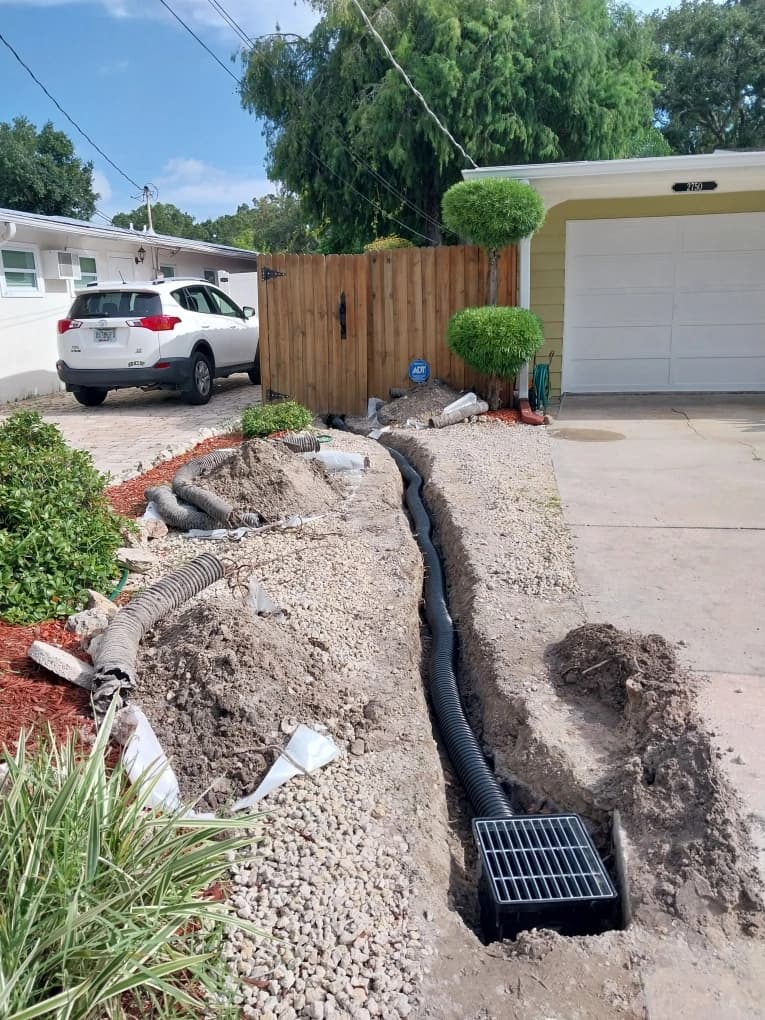
When water is getting somewhere it shouldn't, the solution depends on what kind of water problem you actually have.
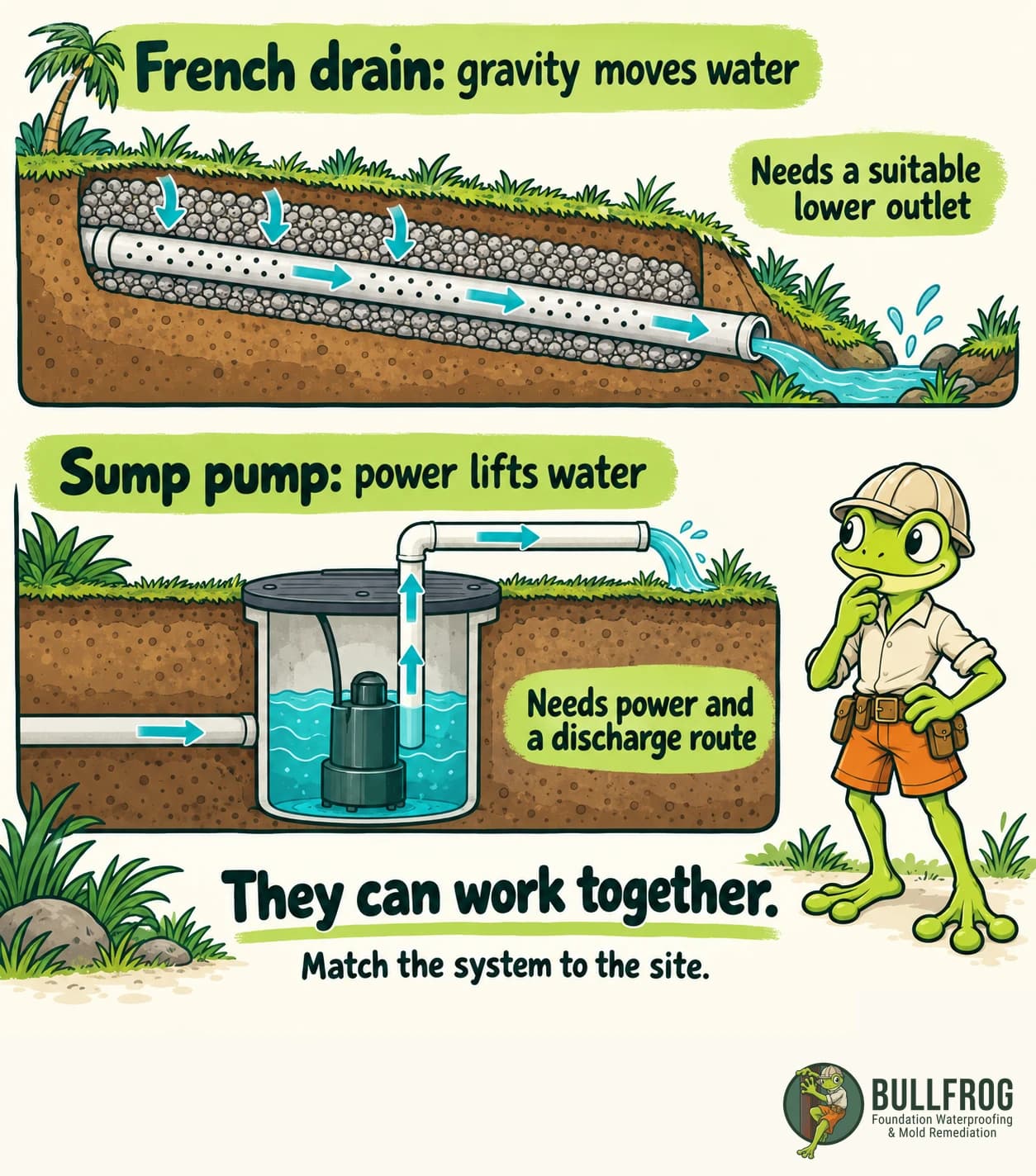
French drains and sump pumps both manage water around and under homes, but they solve different versions of the problem. A french drain works by redirecting water before it reaches your foundation, using gravity to move it away from the structure. A sump pump works by collecting water that has already entered a low point and then mechanically ejecting it to a safe distance. Using the wrong one is common, and the result is a solution that doesn't work and a bill for the trouble.
Florida makes this more complicated than it is in most states. The terrain is flat, which limits how much gravity you can work with. The water table is high, which means you're sometimes dealing with ground pressure rather than surface runoff. The soil varies, with sandy sections that drain well and clay-heavy areas that hold water after a storm. Here's how to think through which system your home actually needs.
How a french drain works
A french drain is a trench filled with gravel and a perforated pipe. The trench is dug at a slope, water flows into the pipe through the perforations and gravity moves it along to a discharge point, typically the street, a dry well or a swale away from the structure.
The system is passive. No electricity, no moving parts, no maintenance beyond keeping the outlet clear. When it works, it works indefinitely. The failure modes are few: a crushed pipe, a discharge point that gets blocked, or a trench that wasn't graded with enough slope to move water effectively.
French drains are the right answer for surface water and shallow groundwater that is being pushed toward your foundation by grade or soil conditions. If water is pooling against your foundation after rain, running along the side of the house toward a low spot, or seeping in through the base of a block wall because the surrounding soil stays saturated, a french drain placed at the right point in the drainage path will intercept it before it becomes your problem.
The critical word is "before." A french drain works by catching water on its way to your foundation and redirecting it. If water has already entered your crawl space or is rising from below rather than moving laterally, a french drain alone won't fix it.
How a sump pump works
A sump pump sits in a collection basin, called a sump pit, that is dug into the lowest point of the space being protected. Water that enters the crawl space or basement drains toward the pit. When the water level rises to a set point, a float switch activates the pump, which ejects the water through a discharge pipe to the outside.
Sump pumps require electricity and have moving parts that wear out. The pump itself typically lasts seven to ten years. The float switch fails before the pump does in many cases. Battery backup systems add resilience against power outages, which is a real consideration in Florida during hurricane season when power loss and flooding tend to arrive together.
A sump pump is the right answer when water is actively entering a space and needs to be removed after it gets there. It handles hydrostatic pressure, the condition where the water table rises to or above crawl space floor level and water pushes in from below regardless of what's happening on the surface. No amount of redirecting surface runoff fixes that problem. The water is coming up, not in.
What makes Florida different
Most guides on french drains and sump pumps assume you have some topographic relief to work with. A slope of at least one percent over the drainage path is the standard minimum for a functional french drain. In practice, that's not a steep hill, but Florida's coastal plain terrain can run nearly flat for miles. Some neighborhoods in Sarasota County, the Tampa Bay lowlands and the subdivisions west of Orlando have grades so slight that gravity-fed drainage doesn't move water fast enough to protect a foundation during a heavy storm event.
Florida's water table is the bigger factor. In many parts of Orange, Hillsborough and Sarasota counties, the water table sits two to five feet below grade during the wet season. When the water table rises to that level, a french drain that terminates underground may end up discharging into saturated soil, which means it backs up and stops working. This is why french drain installations in Florida often need to discharge above ground to a swale or the street edge rather than into a dry well.
Soil type changes the calculation too. The sandy soils common in Central Florida tend to drain reasonably well. Clay-rich soils, found in parts of Metro West, parts of Hillsborough County and some inland Sarasota neighborhoods, hold water after rain and maintain pressure against foundation walls for days. Clay soil makes both french drains and foundation waterproofing more important, and it means the systems need to be sized for more prolonged water pressure.
When a french drain is the right answer
A french drain makes sense when:
Water pools against the foundation after rain and then drains away over a day or two. This is a surface runoff problem. The water is moving laterally, and intercepting it before it reaches the foundation is the right approach.
The crawl space stays dry except during or right after heavy rain events. If water enters only when rain is falling hard and then dries out, you're dealing with surface intrusion rather than water table pressure.
There is a clear grade problem, such as a downslope that directs water toward the foundation, or a neighbor's property that sheds water onto yours.
The existing drainage on the property is poor but there's enough slope to make gravity drainage functional.
When a sump pump is the right answer
A sump pump makes sense when:
Water is present in the crawl space even during dry weather, or when it enters from below rather than through the walls. This is a water table problem. Redirecting surface runoff won't help if the water is coming up from the ground.
The crawl space floods during and after heavy rain and stays wet for days. Surface interception helps at the margins, but water table pressure needs mechanical removal.
The property is in a low-lying area with limited grade, particularly neighborhoods around Windermere, Safety Harbor, parts of South Tampa or coastal Sarasota where the terrain sits close to sea level.
A french drain was already installed but the problem persists. This is often a sign that the water source is hydrostatic rather than lateral, and the french drain is intercepting the wrong water.
When you need both
The honest answer for many Florida crawl spaces is that you need both systems working together. A french drain handles surface and lateral water moving toward the foundation. A sump pump handles water that makes it in despite that or rises from below.
This is particularly true for homes with crawl spaces in areas that experience named storms. Hurricane Idalia made landfall in August 2023 and brought significant flooding to parts of Hillsborough and Pinellas counties. Hurricane Helene hit Tampa Bay in September 2024 with a storm surge that exceeded ten feet in some coastal areas. Homes that had only one layer of water management often found that a single bad storm exceeded the system's capacity.
A french drain paired with a sump pump and crawl space encapsulation is the complete system for a Florida home with chronic moisture issues. Each component handles a different part of the problem. Skipping any one of them leaves a gap that will eventually show up as mold, wood rot or standing water.
Cost comparison for Florida homes
French drain installation costs vary based on linear footage, the depth required and site access. Longer runs, rocky soil or tight access around the foundation increase labor costs. The discharge route matters too. A drain that has to carry water to a swale or the street edge across flat ground is a longer job than one with a short path to an outlet.
Sump pump installation for a crawl space covers the pump, the basin and the discharge line. A battery backup is usually its own line on the quote. If the crawl space pit has to be dug from scratch, or the discharge line has a long route to the outside, the job gets larger.
For homes that need both systems along with encapsulation, the total scope depends on the size of the crawl space and the severity of the water problem. What's under the house varies enormously by age, construction type and how much has already been done, so a useful number only comes after someone has been under it. Bullfrog quotes this work after a free on-site inspection for homeowners and property owners, with a written estimate before any work starts.
Common questions
Can I install a french drain myself? The trench work is physically demanding but not technically complex. The challenge in Florida is getting the grade right when the terrain is nearly flat. If the pipe isn't pitched correctly throughout the run, water pools in the low spots and the system backs up. Hiring someone with drainage experience is worth it in Florida where terrain limitations make the margin for error small.
How long does a sump pump last? Most residential sump pumps last seven to ten years. Float switches tend to fail before the pump motor does. In Florida, pumps in active-duty crawl spaces that run frequently during wet season may need replacement closer to the five to seven year mark. Plan for it.
Will homeowners insurance cover a french drain or sump pump installation? Generally no. Drainage improvements are preventive work and are not covered under standard homeowners policies. If flooding damage results from an inadequate drainage system, that damage may or may not be covered depending on the policy and the source of the water. Flood insurance and standard homeowners policies differ significantly on what they cover.
My crawl space smells but doesn't have standing water. Do I still need a sump pump? Not necessarily. A musty crawl space without standing water often points to humidity and vapor moisture rather than active flooding. Crawl space encapsulation with a dehumidifier may solve the problem without any drainage work. A free inspection will identify whether the source is surface water, vapor or hydrostatic pressure.
If your crawl space or foundation is taking on water and you're not sure which system you need, learn more about our French drain installation and foundation waterproofing services, or call 888-603-MOLD to request a free inspection. We'll identify the source and tell you what will actually fix it.
Protect your Florida home
We find the source of water intrusion and handle waterproofing and mold remediation. Start with a free on-site estimate.
Free on-site estimates are for homeowners and property owners. Renting or buying? See your options.
More from Bullfrog Waterproofing
Waterproofing
Foundation Waterproofing Cost in Florida: What Drives the Price
Foundation waterproofing costs vary by method and water intrusion level. Here is what drives a Florida quote up or down, and what to check before you sign.
· 7 min read
Read article
Mold Remediation
How to Prevent Mold After a Flood in Florida
Mold can start within 24 to 48 hours of a Florida flood. What you do in the first two days decides whether you get mold at all. Here is the playbook.
· 8 min read
Read article
Mold Remediation
Is Black Mold Dangerous? What Florida Homeowners Should Know
Black mold gets talked about like a death sentence. The real risk is more grounded, and in Florida humidity it is common. Here is what the science says.
· 8 min read
Read article