Search this question and the first answer you get is written for Texas. The next few are for Wisconsin, North Carolina, Minnesota and California. Landlord-tenant law is state law, so none of them apply to you. Florida is genuinely different, mostly because of what it does not have.
Who is responsible for mold in a Florida rental
There is no Florida mold law. No statute in Florida requires a landlord to remediate mold and there is no federal one either. What exists instead is a general duty to maintain the property.
Section 83.51 of the Florida Statutes requires a landlord to comply with applicable building, housing and health codes. Where no such codes apply, it requires them to keep roofs, windows, doors, floors, exterior walls, foundations and other structural components in good repair and the plumbing in reasonable working condition.
Read that list again, because it is where mold arguments actually get won or lost. Mold is not mentioned. A roof that leaks, a window that does not seal and plumbing that does not work all are. In a Florida rental, the productive question is almost never whether there is mold. It is what is letting water in and whether that thing is on the list.
Two details worth knowing before anyone quotes the statute at anyone. The extra duties in subsection (2), things like pest control and common areas, apply only to buildings other than single-family homes and duplexes. And for a single-family home or duplex, some of these obligations can be modified in writing in the lease. Your lease matters as much as the statute.
What that means in practice
Responsibility usually follows the moisture rather than the mold.
Where water is getting in through the building, that sits squarely inside the maintenance duty the statute places on the landlord. A leaking roof, a failed window seal, plumbing, or water coming up through the slab all count. Where moisture is being generated inside and never ventilated, long showers with the extractor off, a tumble dryer venting indoors, windows kept shut, what the tenant does becomes part of the picture.
Most real cases are a mix, which is why documentation decides them rather than argument.
What to do as a tenant
You cannot authorize anyone to open a wall or start removal work, because only the owner can. What you can do is build a record that is hard to dismiss.
- Report it in writing, by email or letter, even if you already phoned. Keep a copy with the date.
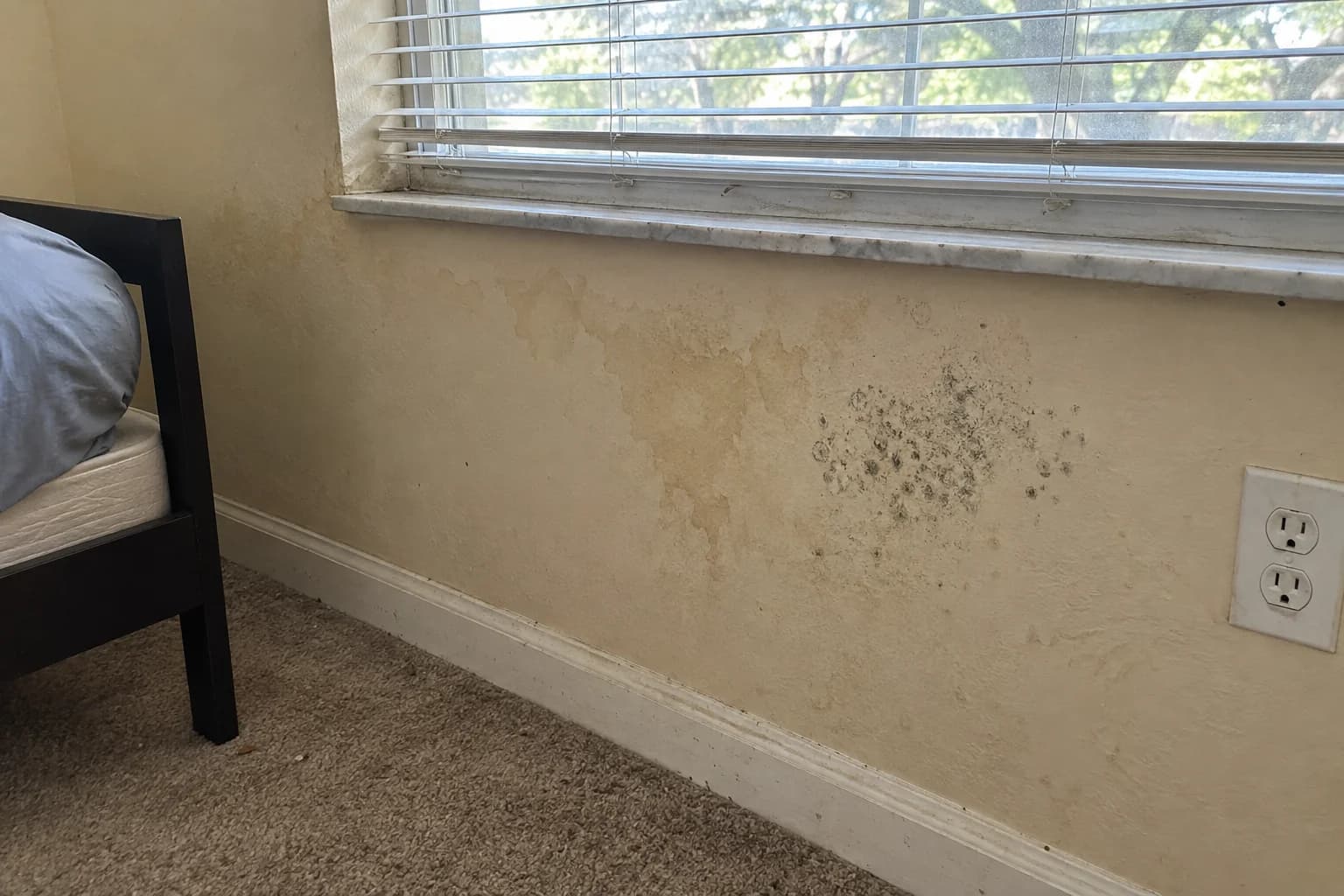
- Photograph the growth and anything near it: staining, a damp patch, a dripping pipe, a window that runs with condensation.
- Note when it appeared and whether it tracks with rain, with a specific appliance, or with nothing obvious.
- Get findings in writing from someone licensed. Two routes work here. Ask your landlord to book an inspection, which is free for property owners and costs them nothing to find out. Or, if the mold has already become a disagreement, hire a licensed mold assessor who samples and sends to a lab. Florida licenses assessors and remediators separately and bars one company from doing both on the same property, so whoever diagnoses the problem has nothing to gain from the size of the repair. In a disagreement, that independence is the whole point.
- Keep every reply. A landlord who responds quickly is a different situation from one who has ignored four emails.
If a landlord will not act, apartments and other public lodging establishments in Florida are regulated by the Department of Business and Professional Regulation, which inspects for safety and sanitation. The Department of Health does not test for mold and does not referee landlord disputes.
For anything involving your lease, your rent or a claim, talk to a lawyer. This is a remediation company writing, not a legal one.
What to do as a landlord or property manager
Speed is the whole strategy and it is cheaper than the alternative.
Water damages material continuously, so a leak reported in week one and fixed in week one is a repair, while the same leak in week six is a repair plus removal plus replacement of anything porous that stayed wet. Respond to the report in writing, get someone out to find the source rather than to look at the stain, fix the source first, then deal with what the water damaged.
Keep the paperwork. An inspection report, dated photographs and an invoice showing what was done and when is the record that resolves a dispute later. An owner arranging one can book a mold inspection in Orlando, mold inspection in Tampa or mold inspection in Sarasota.
One Florida-specific point on hiring. The state licenses mold assessors and mold remediators as two separate licenses and it licenses individuals rather than companies. Ask for a license number and check it on the state register.
Own the property? Get it in writing, dated
Free for homeowners, landlords and property managers: a walk of the property, moisture readings, and written findings that say where the water is actually coming from. Renting? Send this page to whoever owns the building and we will take it from there.
License MRSR5565 · Orlando, Tampa and Sarasota
Can a tenant get a mold test done?
Yes, at their own expense, though it needs care. A tenant can arrange a visual inspection of the unit they occupy. Anything intrusive, opening a wall, lifting flooring, taking apart an air handler, needs permission from the owner because it alters the property.
Whether a test is worth doing is a separate question. Florida's Department of Health does not recommend mold testing, because there are no health or exposure-based standards to evaluate a result against. For a rental dispute the useful document is usually not a lab report but a written record of where the moisture is and what is causing it.
On health, one sentence, because this page is about buildings and paperwork. The CDC states that exposure to damp and moldy environments may cause a variety of health effects, or none at all. If someone in the unit is unwell, that is a matter for a doctor.
Whichever side of the lease you are on, the argument ends the same way. Find the water, document it, fix it. If the same patch returns after cleaning, nobody has found it yet.