The shelf at the hardware store has a mold test kit on it for about ten dollars. Before you buy one, it is worth knowing that the state health department, the CDC and the EPA all think you probably do not need it.
How to test for mold in your house and why the health department says not to
There are three ways to test. A settle plate kit from a hardware store, where you expose a petri dish and wait for something to grow. An air sample, where a pump draws a measured volume of air through a cassette that goes to a laboratory. A surface swab or tape lift from visible growth, also sent to a lab.
All three work in the sense that they detect mold. The problem is what you do with the answer.
Florida's Department of Health does not recommend mold testing or sampling to see if you have a mold problem, or to see what kind of mold might be growing. The CDC puts it in four words: CDC does not recommend mold testing.
Their reason is the same one and it is not about cost. There are no health or exposure-based standards you can use to evaluate a mold sampling result. No federal limits exist for mold or mold spores, so a lab number cannot tell you whether your house passed. Spores are in every building and in outdoor air, so a positive result is close to guaranteed.
The CDC adds the sentence that ends the argument for most homeowners. No matter what type of mold is present, you need to remove it. If the answer does not change what you do, paying to find it out is hard to justify.
What to look for instead
Your eyes and nose are better first instruments than a petri dish. Florida's Department of Health says indoor mold growth can usually be seen or smelled.
- Look for signs of moisture or water damage rather than for mold itself. Water leaks, standing water, water stains, condensation on windows or pipes.
- Follow any earthy or musty odor. If you can smell it, there is something to find.
- Check around the air handler. The health department specifically recommends inspecting evaporator coils, drain pans and drain lines for standing water, which is also how mold reaches the ductwork.
- Look under sinks, behind the washing machine, at window frames and along the bottom of exterior walls.
- Note anything that keeps coming back after you clean it, because that means something is still wet.
Growth looks cottony, velvety, rough or leathery and it can be white, gray, brown, black, yellow or green. Color tells you nothing useful about how dangerous it is.
How to tell if mold is behind walls
This is the question a test kit genuinely cannot answer, because a settle plate on the kitchen counter says nothing about a wall cavity.
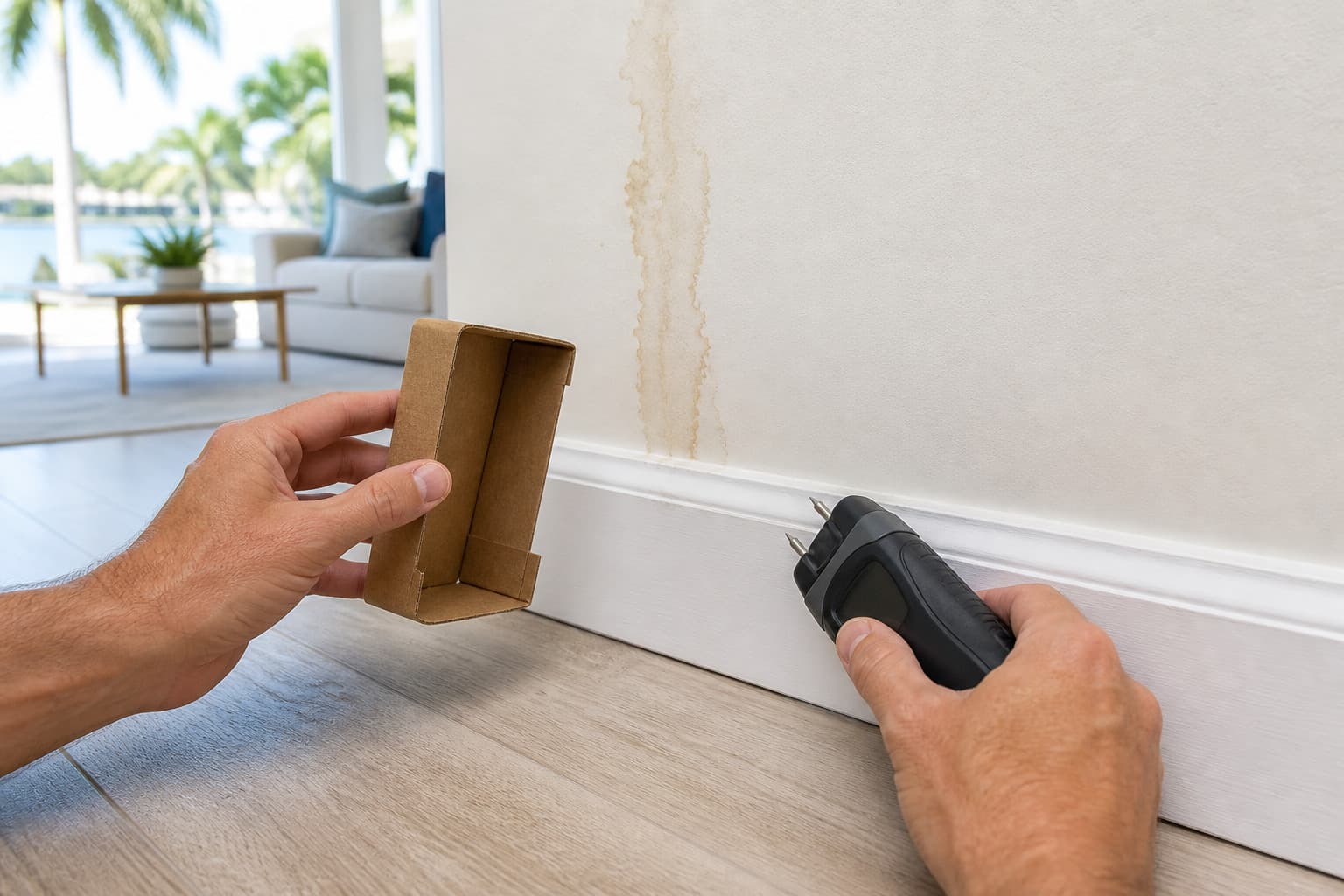
What works is a moisture meter. A pin or pinless meter reads moisture content through the surface, so you can compare a suspect wall against a known dry one on the same wall run. A reading well above its neighbours means water is getting in somewhere, whether or not anything is visible.
The other signs are physical. Paint that bubbles or peels in one patch. A baseboard that has swollen or lifted. A stain that reappears after you paint over it. A musty smell that is strongest at one power outlet, because the wall cavity vents through it.
None of that confirms mold. All of it confirms water, which is the thing you actually have to fix.
Skip the kit. Find the water.
Our free visit is a walk of the whole property with moisture readings on the walls that look fine, plus written findings you keep whether or not you hire us.
Available 24/7 · Written findings included · Free for homeowners
When a test is worth paying for
There are real cases and the EPA names the main one. Surface sampling may be useful to determine if an area has been adequately cleaned or remediated. That is verification after the work rather than diagnosis before it.
The others are practical rather than medical. A real estate transaction where a buyer or lender wants documentation. An insurance claim or a dispute with a landlord where you need a third-party record. A building where people are unwell and a doctor has asked for it.
If you do sample, the EPA is clear about who should do it. Sampling should be conducted by professionals with specific experience in designing sampling protocols, sampling methods and interpreting results. A kit that comes with no interpretation is not that.
Can you clean it up yourself?
Often, yes. The EPA is careful to say size is one factor among several rather than a rule, but its working threshold is about 10 square feet, roughly a three foot by three foot patch. Under that, most people can handle it.
Above that, or where water damage is extensive, it becomes a job for someone with containment equipment. Two things override size entirely: water that came from sewage or flooding and growth you suspect has reached the air handler or ductwork.
On health, one sentence, because this page is about buildings. The CDC states that exposure to damp and moldy environments may cause a variety of health effects, or none at all. If someone in the house is unwell, that is a question for a doctor.
The useful version of testing for mold is finding the water that feeds it. That is a walk of the property with a moisture meter rather than a petri dish on the counter. Bullfrog Waterproofing holds Florida Mold Remediator License MRSR5565 and offers a free mold inspection across Orlando, Tampa and Sarasota.