Most advice about black mold in AC vents stops at the register. Take the cover off, scrub it with vinegar, put it back, change your filter. That removes what you can see without touching the reason it appeared. The EPA publishes guidance on this that is more useful than almost anything you will read on the subject and it starts with an instruction most people get wrong before they pick up a cloth.
What causes mold in air conditioner vents
Cold air moves through a metal register while warm humid air sits against the other side of it. Where those two meet, water condenses on the metal and household dust settles into that water. Mold needs moisture, a surface and something organic to eat. A damp dusty vent gives it all three.
Florida makes this worse than almost anywhere else. The National Weather Service dates the start of the rainy season anywhere from the middle to the end of May depending on which part of the state you are in. It runs through to the middle of October, delivering 60 to 70% of the year's rainfall in South Florida. Air conditioning runs almost continuously across those months, so the temperature gap across the vent metal never closes. In most Orlando homes the ductwork also runs through an unconditioned attic that sits well above outdoor temperature on a summer afternoon, which puts cold ducts inside a hot humid box for months at a time.
Signs of black mold in AC vents
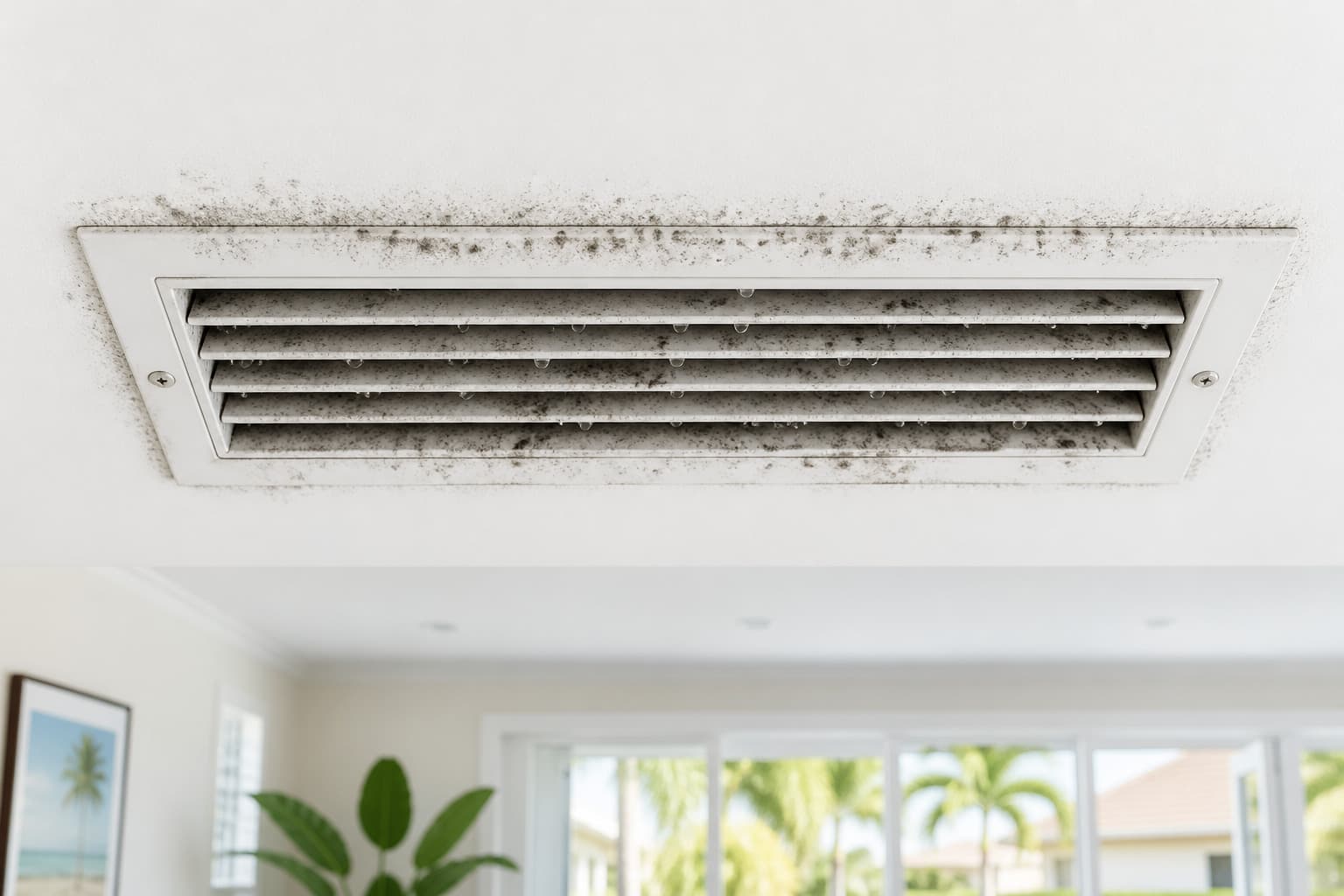
Black specks around one ceiling register are common here. When every register in the house looks the same, the problem sits in the system rather than the registers.
- A musty smell that appears when the system starts and fades when it stops
- Dark speckling on the register face or on the ceiling paint immediately around it
- Water beading on the vent fins while the system runs
- Growth that continues past the register face when you look into the duct opening
- Peeling or bubbling paint on the ceiling around the vent
Only laboratory analysis confirms a specific mold species. For a homeowner that distinction matters far less than finding the water, because the repair is the same either way.
Where the moisture actually starts
The EPA identifies condensation on or near the cooling coils of air conditioning units as a major factor in moisture contamination of a duct system. The coil pulls water out of the air by design. That water collects in the drain pan underneath it. When the pan stops draining properly, or the condensate line clogs, you get standing water inside the air handler feeding everything downstream of it.
Three other places are worth checking before you blame the vent:
- Duct insulation in the attic. Where insulation is thin, torn or missing, the duct surface drops below the dew point of the air around it and sweats.
- Air leaks around the vent boot. Gaps let unconditioned attic air meet the cold register directly, which is why one vent can go black while the rest stay clean.
- The size of the air conditioner. The EPA notes that a unit that is too big cycles on and off frequently, which results in poor moisture removal, particularly in areas with high humidity. A short-cycling system cools the house quickly then shuts off before it has dehumidified anything. Florida homes with an oversized unit stay cold and damp.
Turn the system off before you clean anything
The EPA is direct about this. Do not run the HVAC system if you know or suspect that it is contaminated with mold, because it could spread mold throughout the building.
Running the air handler while you scrub a moldy register pushes spores into every room the ductwork serves. Shut the system down at the thermostat first, then inspect.
What you can clean yourself
If the growth sits on removable registers or grilles, that is a small job. The EPA's general threshold for do-it-yourself mold cleanup is about 10 square feet, roughly a three foot by three foot patch.
- Turn the system off at the thermostat.
- Unscrew the register and take it outside.
- Wash it with detergent and water. The EPA recommends detergent and water over stronger products for hard surfaces.
- Dry it completely before it goes back. A damp register reseeds itself within days.
- Replace the air filter.
- Look inside the duct opening with a flashlight before you refit the cover.
Step six is the one that matters. Clean bare metal inside the duct means you probably caught a surface problem. Growth spreading back into the duct, or soft fibrous lining that looks stained or damp, means stop.
What you cannot clean and why
Two facts from the EPA's duct guidance rule out most of what gets recommended online. Wet or moldy insulated ductwork cannot be cleaned. It has to be replaced. Fiberglass duct board and fiberglass-lined flex duct are common in Florida homes built since the 1970s and once mold is in that material, scrubbing the surface leaves the growth inside it.
There is also no spray that legally fixes this in a fiberglass duct. People ask constantly whether something can be fogged through the system. The EPA has not registered any product as a biocide for use on fiberglass duct board or fiberglass-lined ducts. It registers a small number for bare sheet metal only. Anyone offering to spray a treatment through a fiberglass-lined system is using a product outside its registered use.
| Duct type | Can mold be cleaned out of it? | What to do |
|---|---|---|
| Removable metal register or grille | Yes | Detergent and water, dried fully before refitting |
| Bare sheet metal duct | Yes | Clean first, then treat only with a product registered for sheet metal ducts |
| Fiberglass duct board | No | Remove and replace the affected sections |
| Fiberglass-lined flex duct | No | Remove and replace the affected sections |
The EPA also rules out steam cleaning and every other moisture-based method on any kind of ductwork. Adding water to a system with a moisture problem makes it worse.
Why duct cleaning on its own does not stop it coming back
The EPA does not recommend routine duct cleaning. It recommends it as needed. It also says something sharper about how the service gets sold: do not hire duct cleaners who make sweeping claims about the health benefits of duct cleaning, because those claims are unsubstantiated.
The line that matters most for a Florida homeowner sits in the same document. If the conditions causing the mold growth in the first place are not corrected, mold growth will recur.
A cleaned duct in a house with a clogged condensate line, uninsulated attic ducts or 70% indoor humidity looks clean for one season. Cleaning is real work. It does not fix whatever made the duct wet.
Mold at the vents? We inspect the whole system, free.
We look at the air handler, the coil, the drain pan and the ductwork, not just the vent you can see. Written report, no obligation.
Available 24/7 · No obligation · Free estimates for homeowners
When to call a licensed professional in Florida
Call someone if any of these apply:
- Growth covers more than about 10 square feet
- You can see growth inside the ducts rather than only on the register faces
- The ducts are fiberglass duct board or fiberglass-lined and the lining looks stained or damp
- There is standing water in the drain pan or the condensate line is blocked
- The musty smell returns every time the system starts, even after cleaning
- Growth has come back in the same place after a previous clean
The EPA treats suspected HVAC contamination as its own trigger to stop and get guidance, separate from the 10 square foot rule, because ductwork carries whatever is in it to every room in the house. If anyone in the house has health concerns about the exposure, that is a question for a doctor. The CDC publishes what is known about mold and health and it varies a great deal between people.
Check licensing before you hire. The EPA's own guidance lists Florida among the states that require air duct cleaners to hold special licenses. Ask for the license number. Bullfrog Waterproofing holds Florida Mold Remediator License MRSR5565 and we handle professional mold remediation and the water source that caused it in the same project. We cover mold remediation in Orlando, mold remediation in Tampa and mold remediation in Sarasota.
How to prevent mold in AC vents
- Keep indoor humidity under 50%. A hygrometer costs less than a filter. Through the rainy season this is the one number worth watching.
- Check that the air conditioner is the right size for the house. An oversized unit cools fast then stops, which leaves humidity behind.
- Seal and insulate every duct run in the attic. Cold duct inside a hot attic sweats wherever the insulation has failed.
- Flush the condensate line at the start of the rainy season. A blocked line puts standing water directly under the coil.
- Change filters on schedule. Less dust in the system means less food for anything that gets damp.
If mold keeps returning to the same vent after all of that, something is still wet. A leak above the attic run, a failed vapor barrier in the crawlspace or water entering at the foundation will keep feeding the system no matter how often the ducts get cleaned. A free mold inspection finds which one it is.