
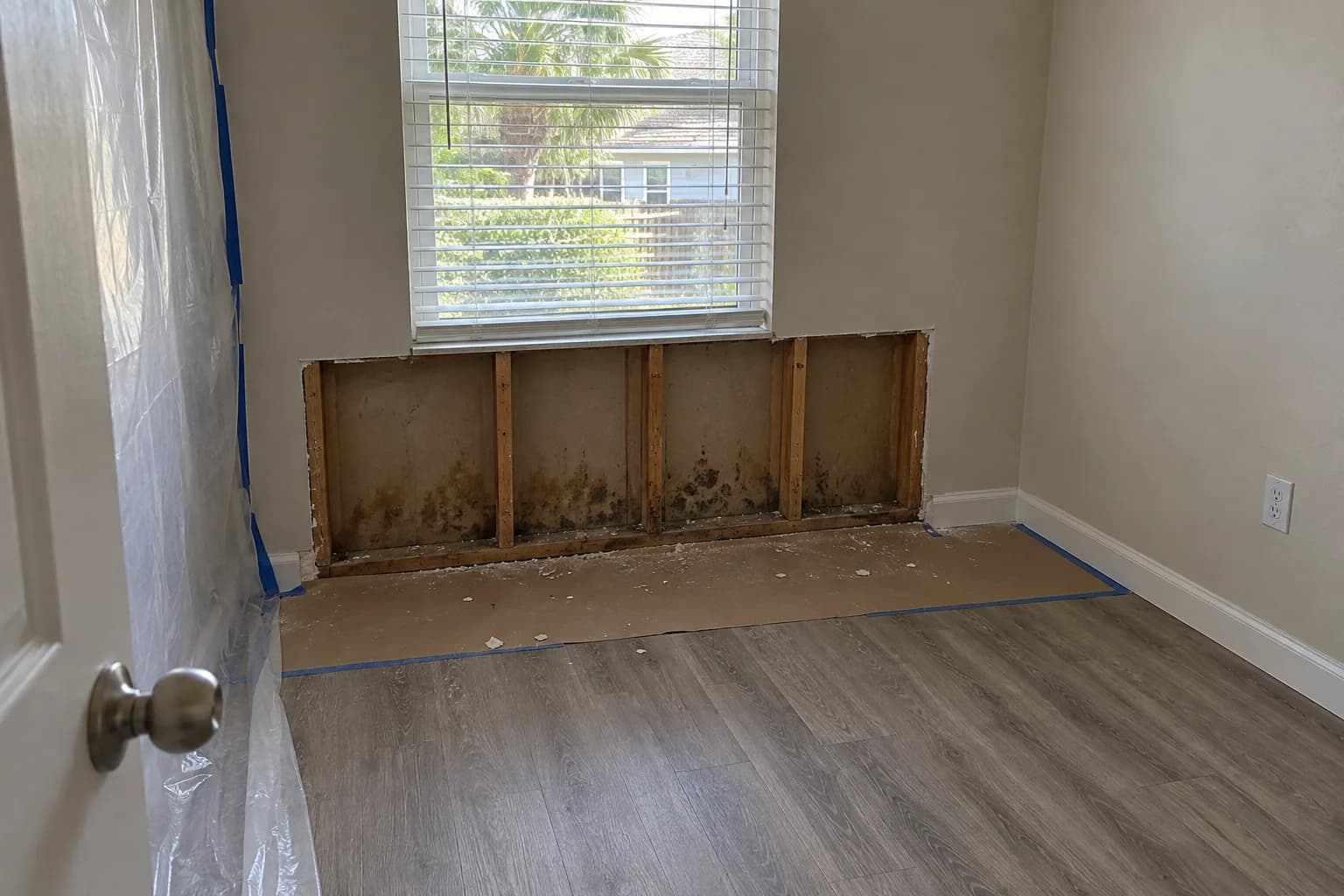
Demolition is when a house shows what it has been hiding. The tile comes off the shower wall or the old cabinets come out and the back of the drywall is black. Nothing about the remodel has gone wrong. The wall was wet long before the crew arrived and it will never be easier to fix than it is today, while it is open.
What to do first when a remodel uncovers mold
- Stop demolition in that spot. Tearing out moldy board spreads what is growing on it. The EPA lists the back of drywall among the places hidden mold grows and uses wallpaper to show the risk: stripping it can release a massive number of spores when mold is growing underneath.
- Keep the air still. Turn off any fan pointed at the wall. The EPA also advises against running the HVAC system if you know or suspect mold has got into it.
- Close the room off. Shut the door or tape plastic over the opening. Dust from the rest of the job stays out and whatever is in the wall stays put.
- Photograph it before anything changes. Take wide shots and close-ups with a tape measure in frame. They help the remediator, the remodeler and any insurance claim.
- Find the water. Mold in a wall means water in a wall. Nobody should rebuild until someone traces it to a pipe, a shower pan, a window or the slab.
How much mold is too much to handle yourself?
About 10 square feet, which is a patch roughly three feet by three feet. Below that size the EPA says most people can handle the cleanup themselves. Above it the agency sends you to its guidance for professional remediation.
Florida uses the same number. State law defines mold remediation as removing or treating more than 10 square feet of mold (Fla. Stat. 468.8411). Paid remediation of that size generally needs a state-licensed mold remediator. The law exempts some people, including homeowners working on their own house and licensed contractors working inside their own trade (s. 468.841). On a real job your remodeler may deal with a small patch. A wall full of it belongs to a different trade.
EPA guideline and Florida law
How much mold is too much to handle yourself
- About 10 square feetRoughly 3 by 3 feet. Below that size, the EPA says most people can handle the cleanup themselves.
- More than thatFlorida law calls it mold remediation (Fla. Stat. 468.8411). Paid work of that size generally needs a state-licensed mold remediator.
Your remodeler may deal with a small patch. A wall full of it belongs to a different trade.
Source: EPA, Mold Cleanup in Your Home
Why the water matters more than the mold
Mold in a wall is evidence of a leak, so the leak is what has to be found. A crew can remove every board that grew something and the same wall will turn black again within a season if water still gets in.
In a kitchen or bathroom the water usually comes from one of four places:
- A supply line or drain dripping inside the wall. A plumber fixes that before anything else happens.
- A shower pan or tub surround that lets water through to the framing.
- A window or roof penetration above the room that lets rain in.
- Water coming through the foundation, where a block wall wicks it up into the drywall from below.
Whoever removes the mold should also tell you which of these it was. Mold that keeps coming back usually means a source nobody fixed.
When can the remodel start again?
The remodel can restart once three things are true: the water source is fixed, the moldy material is out and what stays behind is dry.
A remediator removes the porous material mold has grown into, because the EPA notes that absorbent materials may have to be thrown away once they are moldy. The crew cleans and dries any framing worth saving. The wall should then read dry on a moisture meter before any board, tile or cabinet goes back. Closing a damp wall means doing the same job twice.
Do not let anyone paint, caulk or tile over it to protect the schedule. The EPA says plainly not to paint or caulk moldy surfaces.
If we encounter mold during or before our work, we stop work in that area and tell our property owner immediately. It gets dealt with properly before anything is closed back up.
Ax Torres, Pristine Remodeling
Who does what
Three trades share a job like this. A plumber or roofer stops the water at its source. A licensed mold remediator removes what the water ruined and dries the structure. Your remodeler then picks up where they left off.
Bullfrog Waterproofing holds Florida Mold Remediator License MRSR5565. We handle the mold remediation, the dry-out and water that comes through the foundation in one project, so your remodeler gets a clean dry wall back. Homeowners on the Gulf Coast can start with mold remediation in Tampa.

Wall open and mold inside? Get it checked before it closes.
We find the water, remove the mold and dry the structure so your remodel can carry on. Free visit, moisture readings, written findings you keep.
License MRSR5565 · Orlando, Tampa and Sarasota · Free for homeowners
What to ask before the wall closes
- Where did the water come from and who fixed it?
- What did the moisture meter read on the framing before you closed it?
- What came out and what stayed?
- Can I have the photos of the open wall after cleanup?
Keep the answers and the photos with your house records. A buyer or an inspector may ask what was behind that wall. If you want a lab result as well, our guide to mold testing explains when one is worth having.